Surrogate vs Natural Keys in Customer-Facing Exports
Export files need natural keys so customers can reconcile and debug their own data.

Inside a well-run warehouse, the surrogate-versus-natural-key question has a settled answer. Surrogate keys serve as the primary key for every dimension, and the natural key rides alongside as an attribute: the surrogate does the machine's work, the natural key does the human's work, and the audit trail gets both. That internal consensus holds up fine until the moment a key leaves the warehouse and lands in a file a customer opens. The customer receiving that file sits on the human-and-audit side of the equation, not the machine side, and the settled internal pattern was never built with that audience in mind. For SaaS product teams shipping data directly to customers, the key becomes a customer-visible API contract rather than a schema detail: a value the customer's own systems will reference, store, and build logic around. That shift in audience is what this piece calls the customer-facing export, and it's the terrain the rest of this argument covers.
What a natural key and a surrogate key each do, and the single job each is good at
Every key in a data model is asked to do two separate jobs: establish identity (which row is this?) and carry business meaning (what does this row represent?). The surrogate-versus-natural tension exists because those two jobs pull in opposite directions, and no single value satisfies both equally well. A natural key is a value that already exists in the business domain: a customer email, a product SKU, an order number from the source system, an ISO country code, an employee ID. Its appeal is immediate. Analysts and compliance officers can read it without translation, and it requires no lookup table to make sense of. Its weakness is that business meaning is mutable. Customer 123 in one application and customer 123 in another are not the same warehouse identity unless a source namespace disambiguates them, and natural keys rarely carry that namespace on their own.
A surrogate key, by contrast, is a system-generated identifier with no business meaning attached. It exists only to identify a row, implemented as an auto-increment integer, a 128-bit UUID, a GUID, a high-low generation strategy, or a sequence object. Its appeal is stability: it stays compact, it never shifts when the business changes underneath it, and it enables techniques like SCD Type 2 history tracking that a mutable key cannot support. Its failure mode appears at the export boundary, where a value with no business meaning is also, by design, not human-readable, which leaves customers unable to work with it directly.
Why surrogates dominate internal warehouse design
Good internal warehouse design is what produces the opaque exports customers complain about, and understanding that connection matters more than assigning blame. A history-preserving dimension modeling technique requires surrogates by construction: keeping history means inserting a new row every time a customer's attributes change, same natural key, new surrogate key, and a natural key alone cannot represent multiple historical versions of the same entity as a primary key. Join performance adds a second, harder-edged reason. A 64-bit integer key joins and indexes more cheaply than a long composite natural key such as (region_code, order_number, line_no), and on large fact tables that difference shows up directly in query cost and load times. In dbt-based pipelines, the common implementation is a hash of the natural key plus the source system, using something like dbt_utils.generate_surrogate_key('source_system', 'order_number'), so the natural key isn't discarded so much as compressed into a single stable surrogate anchor.
None of this is negligence. It's the rational outcome of applying internal best practice without export in mind. But when that warehouse is correctly designed, with surrogate primary keys and fact tables carrying those surrogates throughout, an export that simply surfaces the underlying schema hands customers keys that mean nothing outside the vendor's own system. That problem becomes acute the moment the export is embedded directly into a customer-facing application, the kind of integration platforms like Prequel enable at scale, where reconciliation and debugging depend on identifiers a human can actually recognize. Stable reference data, where the key is genuinely immutable and standardized, such as ISO country codes, currency codes, or a calendar date key, is a legitimate exception to carry forward. These carry no SCD requirement and won't change, so a surrogate adds no real protection there, and a natural key works fine.
Why replacing the surrogate entirely is not the answer
Swapping every surrogate for a natural key throughout the export looks like the obvious fix for customer readability, but it transfers the warehouse's own instability problems straight onto the customer's downstream systems. Natural keys stay coupled to the business they describe, so when a business rule changes, every table where that key appears as a foreign key needs updating, not just the originating table. Two acquired systems can each issue an order numbered 10045, and a natural key that looks unique inside one system is not unique once a customer's data spans more than one source. Composite keys built to force uniqueness carry their own fragility, since every foreign key referencing them must carry all the component columns, and a change to any single component cascades through every downstream join.
The sharpest reason to avoid a pure natural-key export is PII exposure. Natural keys drawn from real-world identifiers, an email address, a Social Security Number, often contain sensitive data by nature, and using them as the primary join mechanism broadcasts that data across every related table in the export, creating direct GDPR and CCPA exposure. A pure natural-key export doesn't solve the customer's problem so much as relocate it: the customer now absorbs the versioning and collision-handling work the warehouse used to do internally, and may receive regulated identifiers structurally embedded in places they shouldn't be.
How Customers Use Exported Keys
Choosing a key strategy requires knowing what customers actually do with the keys once the file reaches them, and three workflows dominate that usage: reconciliation, debugging, and joining to their own systems, each with different requirements. Reconciliation is the most immediate. Customers receiving an export need to match rows against their own CRM, ERP, or billing system, and for that task, the natural key, an account number or an order ID carried over from the source system, is the only handle that works. A surrogate key generated inside the vendor's warehouse carries no meaning in the customer's own systems and can't be matched against anything they hold.
Debugging runs the same direction. The natural key is how a row gets traced back to its source, how counts get reconciled against the system that originated them, and how an analyst figures out what went wrong when a pipeline behaves strangely. That applies as much to the customer's own analysts as to the vendor's engineers investigating a support ticket. Joining exported data into a customer's own warehouse model or analytics stack asks something different: a stable key to build models on, which surrogates can provide, but only if the customer can trust that the vendor won't silently regenerate them on the next pipeline rebuild. Once a surrogate key is displayed to end users and they start building workflows around its actual value, it has effectively acquired business meaning whether the vendor intended that or not, which quietly erodes the original advantage of using a surrogate. And when an export carries only opaque surrogates, mapping a single log entry back to a recognizable business event requires a join through an internal mapping table, a step that can fail during incident response and that compliance auditors end up reconstructing by hand.
The compliance and security dimension that makes key choice a data governance decision
For SaaS products operating under SOC II or comparable compliance frameworks, the key inside a customer-facing export is part of the audit and access-control surface that auditors directly examine, not a private implementation choice. Auditors increasingly expect continuous-monitoring exports or programmatic evidence with timestamps demonstrating that controls operated throughout the audit window, and an export built only from opaque surrogates is harder to map back to specific customer records when that window gets reviewed. Row-level security compounds the stakes in multi-tenant systems, where access rules scope each customer's users to their own organization's data, typically enforced through a tenant identifier. When that identifier is an opaque surrogate, customers have no independent way to confirm they're seeing only their own data. When it's a recognizable natural key, an account number they already know, they can check it themselves.
The PII constraint resurfaces here as a governance rule rather than a design preference: natural keys carrying email addresses or Social Security numbers should stay as attributes available for lookup, never get promoted into the structural join key that the customer's own systems depend on. Distributed and private-cloud deployments raise a related, more technical constraint. Surrogate schemes built on centralized sequence generation, auto-increment integers chief among them, introduce a coordination bottleneck that doesn't fit customers with strict data residency requirements. Deterministic hashing, MD5 or SHA-256 applied to business attributes, lets surrogate values get generated asynchronously without a central authority, which matters directly for customers running on-premises or in a private cloud. Prequel, which lists cloud-hosted, private-cloud, and self-hosted deployment among its supported configurations, is a concrete instance of infrastructure built to accommodate exactly this constraint. Security logging adds a final layer: data access and export events need to be captured at minimum, and the natural key is frequently the bridge between a log entry and the business event it corresponds to. Its absence forces a join through an internal mapping table, which is one more point of failure during an active incident.
The hybrid pattern that resolves the tension: join on surrogate, audit on natural
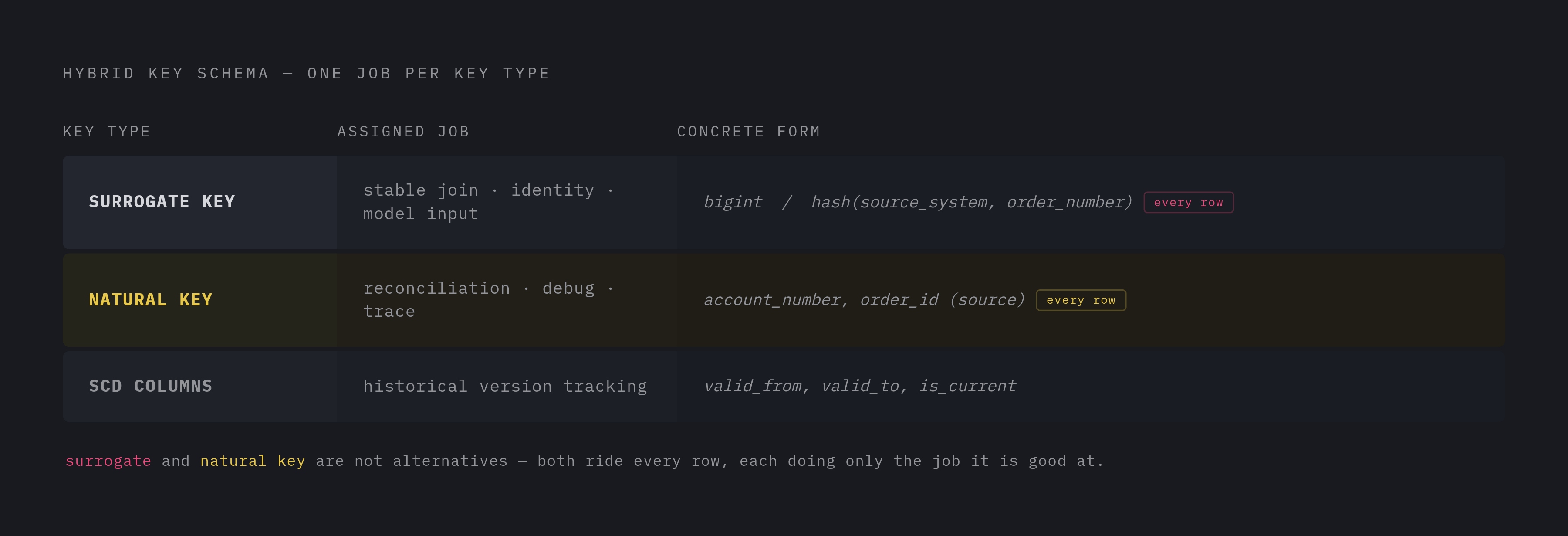
A customer-facing export does not have to pick a side in the surrogate-versus-natural debate. The hybrid pattern carries both keys, assigns each one the single job it's actually good at, and lets the customer reach for whichever one fits the task in front of them. This is the same dimensional modeling logic that already governs internal warehouse design, applied one layer further out: the surrogate serves as the stable, compact join key for identity and for building models, and the natural key rides beside it as a queryable attribute for traceability, reconciliation, and debugging.
Applied to an actual export schema, a dimension carrying both might include a stable surrogate, either a bigint or a deterministic hash, as the join key customers build their models against; the source natural key, an account number or an order ID from the originating system, as an attribute available for reconciliation; and, where SCD Type 2 history is exposed, valid_from, valid_to, and is_current columns so the customer can tell which version of an entity a given fact row actually points to. Hash-based surrogates, generated through something like dbt_utils.generate_surrogate_key('source_system', 'order_number'), are the preferred implementation here, since deterministic hashing lets the surrogate be regenerated from the same inputs without central coordination, solving the private-cloud bottleneck while giving the customer a surrogate they can independently verify.
The customer gains a join key that won't shift under them when business data changes, plus the business context to reconcile against their own systems without a round-trip back through the vendor's API. The vendor gains protection for its internal model from direct customer-side coupling, along with the audit coverage that compliance frameworks expect and a measurable drop in "I can't find this record" support tickets. Adopting a surrogate and then dropping the natural key undoes all of it. The natural key is how a row gets traced to its source, how counts get reconciled, and how a pipeline anomaly gets debugged, and removing it from a customer-facing export removes the customer's ability to self-serve on any of those questions.
AI agent access and the key design calculus
AI agents querying customer-facing export data directly add a new dimension to this calculus. An agent traversing a dataset that carries only surrogate keys cannot resolve entity identity on its own; it needs an additional lookup call to figure out what a given row actually refers to, which adds latency and a new point of failure to every agentic workflow built on top of the export. An agent that can read the natural key alongside the surrogate can resolve a request like "find all orders for account ACME-001" directly, with no API round-trip back to the vendor's system required.
This has a direct consequence for semantic layers built to support natural-language querying: that layer has to carry the natural-key vocabulary even when the underlying export joins on surrogates, or the agent has no readable labels to map user questions onto. Row-level security enforced through a tenant surrogate in the export file requires every consuming AI agent to know and correctly apply that surrogate value, and a recognizable natural key, an account identifier a human or an agent can both verify, makes that coupling more robust and easier to audit. The practical conclusion is that the hybrid pattern is more durable than a surrogate-only export specifically because it hands both human analysts and AI agents the vocabulary they need without forcing an extra resolution step in between. Infrastructure built around AI agent access to exported data, an area Prequel has positioned itself around, is a direct beneficiary of getting this pattern right at the schema level.
Practical decisions when designing the key strategy for a customer-facing export
The hybrid pattern is the right default, but four questions determine which implementation details actually matter for a given export.
Does the entity change over time in ways the customer needs to track? If so, expose SCD Type 2 columns, valid_from, valid_to, is_current, alongside the surrogate, so the customer can join facts to the correct historical version of the entity. The surrogate is what allows two versions of "the same" customer to coexist as distinct rows that facts can correctly reference, while a natural key as the primary key can represent only one.
Does the natural key contain PII? If so, keep it available as a queryable attribute, but do not promote it into the join key the customer's downstream systems structurally depend on, and consider whether it should be masked or withheld from the default export. Using an email address or a Social Security number as a primary join mechanism broadcasts that data across every related table, creating direct GDPR and CCPA exposure.
Is the data stable reference data that will never meaningfully change? If so, a surrogate adds ceremony without benefit. ISO country codes, currency codes, and calendar date keys are immutable and standardized enough that natural keys are the right choice outright, and this is the one legitimate exception to the hybrid default.
Does the customer's deployment require distributed or private-cloud key generation? If so, favor deterministic hash-based surrogates over auto-increment integers, since hashing from business attributes allows surrogate generation without coordinating with a central authority, supporting genuine data residency isolation, the kind private-cloud and self-hosted deployment options, including Prequel's, are built to accommodate.
None of this holds up without documentation. The grain of each table needs to be defined explicitly, the source identifier needs to be retained rather than discarded, and the method by which the surrogate is generated and backfilled needs to be written down somewhere the customer can read it. Without that documentation, a customer has no way to trust that the surrogate key they join on today will still be the same value after the next pipeline rebuild, and that trust is the point of getting the key strategy right.