Schema Versioning and Breaking Change Management for Exported Tables
Breaking schema changes to exported tables risk cascading failures across dependent systems.
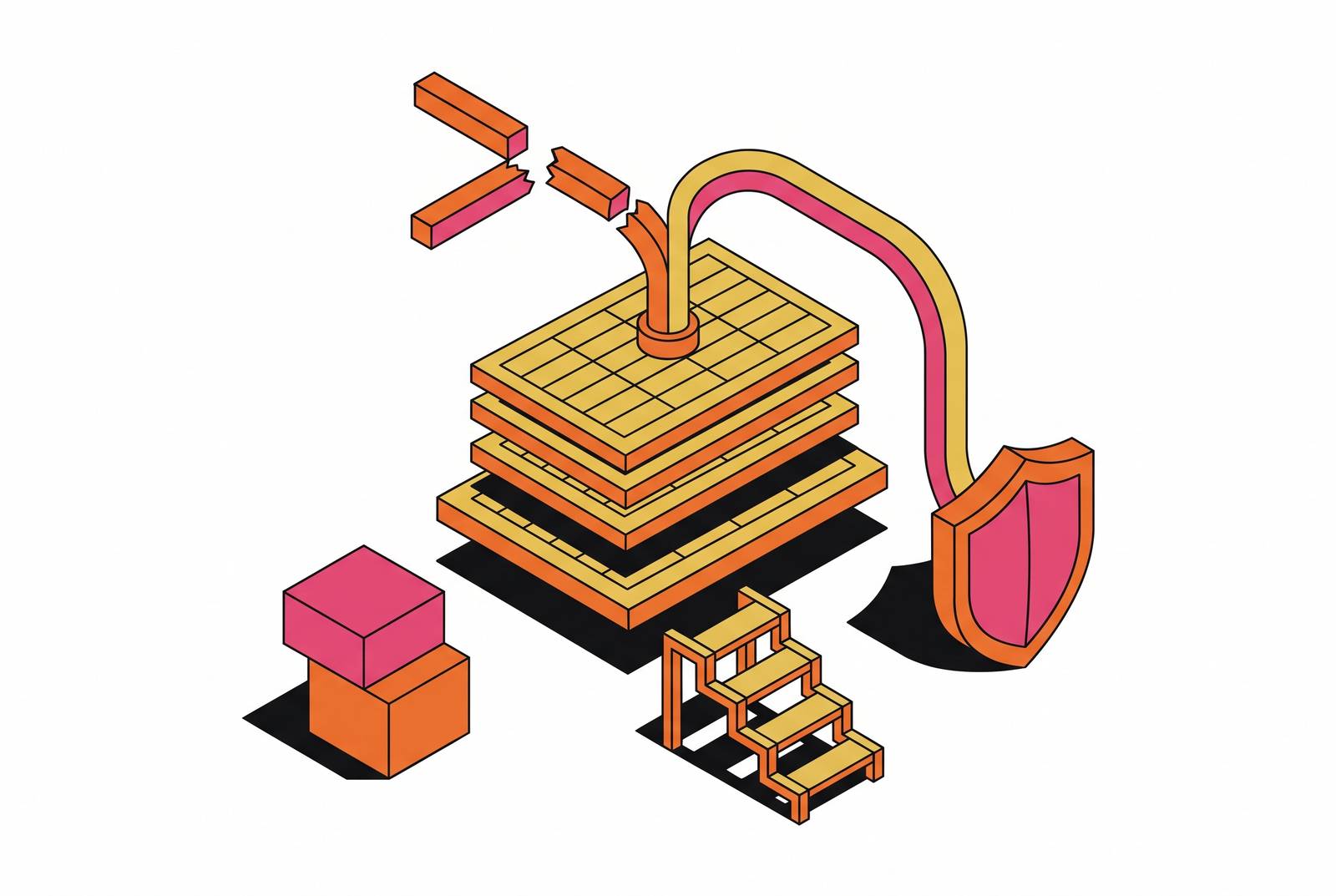
A source team renames a column, user_id becomes customer_id, and within hours five dashboards show blank values while two ML pipelines fail outright. A table changed shape, and everything built on top of it assumed the old shape would hold. That assumption is the whole problem: an exported table schema functions as a contract between the team that produces it and every system that reads it, and breaking that contract without warning is the same failure as changing a REST API endpoint with no version bump and no notice.
Schema changes rarely get that same scrutiny because they often happen by accident rather than design: a source system updates how it exports data, an engineer renames a column to make it more readable, a new field gets added without anyone checking who depends on the old layout. None of those changes go through a review process built for contract-breaking. They just ship, and the breakage occurs downstream, disconnected in time and team from whoever made the change.
The contract itself is wider than column names and data types. Teams that believe documentation solves this are missing the mechanism that actually matters: a schema is a real contract only when it's checked by machines at the boundaries where data moves from one system to the next, not when it's described in a wiki page nobody reads before shipping a change.
Not all schema changes carry the same risk, the breaking vs. safe split
Knowing that schemas function as contracts is only useful if a team can say, concretely, which changes honor the contract and which ones void it. The split between the two is narrow enough to write down as a short set of rules, and a team that cannot state the rule in a sentence has no real basis for enforcing it later.
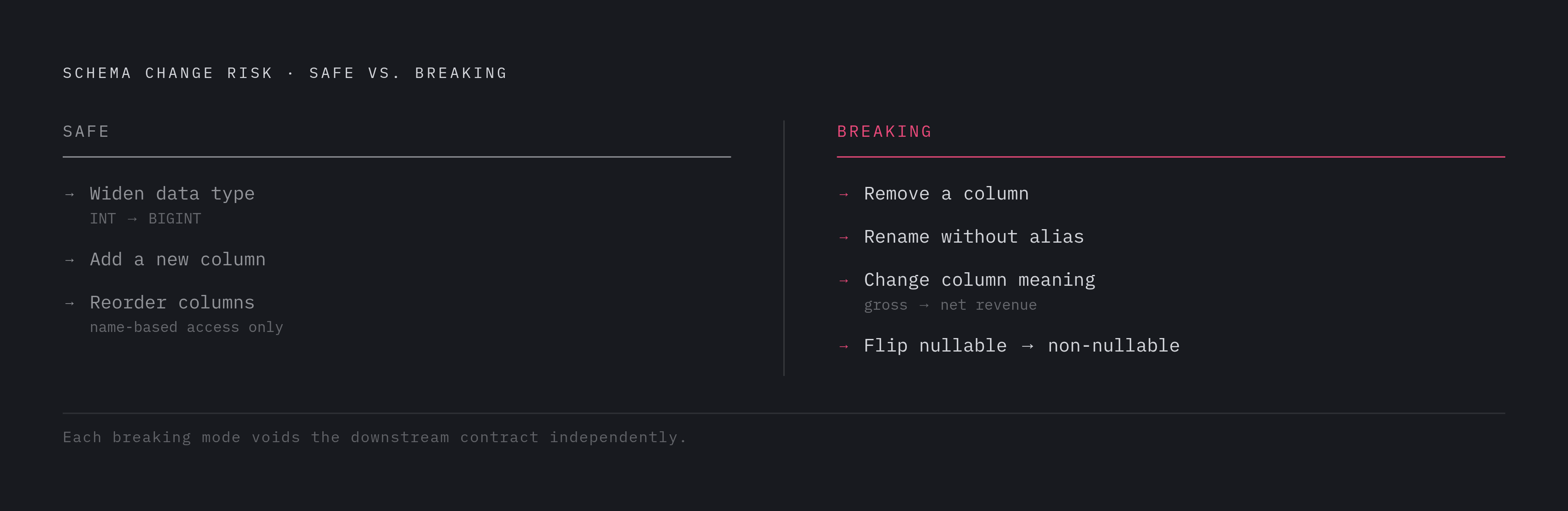
On the safe side sit the changes that extend a schema without disturbing what already exists. Widening a data type, moving an INT to a BIGINT, keeps every existing value representable under the new type. Reordering columns is safe too, but only for consumers that reference fields by name rather than by position, which is itself a reason to treat name-based access as the only acceptable convention for anything exported downstream.
On the breaking side sit the changes that take something away or change its meaning out from under existing consumers. Removing a column that any consumer still references will fail every query that touches it. Renaming a column without preserving the old name under some form of alias produces the exact dashboard-blanking failure described above. Changing what a column means, as with gross versus net revenue, breaks nothing structurally while breaking everything that depends on interpreting the number correctly. And flipping a column from nullable to non-nullable will reject any downstream write or validation step that still expects nulls to be a legitimate possibility.
A change counts as backward-compatible only if it causes no loss of existing data and no disruption to queries already running against the table, since avoiding exactly that kind of disruption is what makes a change safe. A sudden column addition, an unannounced type change, or a full table restructuring can produce any of these outcomes, from an outright pipeline failure to a quietly wrong report that nobody questions until someone notices the totals don't reconcile.
Three cases of breaking changes in production
The taxonomy above is not theoretical. Three versioning approaches, each with a different fit, show how breaking schema changes actually play out once they leave the design discussion and reach production systems.
NetSuite's migration toward a new analytics data source, NetSuite2.com, spanning 2025 and 2026, introduced a schema that diverged from the one teams had built against for years, and record types and fields present in the old schema were removed or renamed in the new one. The standalone Invoice table was deprecated outright, with queries required to go through the unified Transactions table instead, and the TimeEntry table's data was relocated into TimeBill. The failures appeared one tier at a time as the schema change worked its way through every downstream layer in order, each one failing a little later than the last as the change propagated through the stack.
Microsoft's Fabric Data Warehouse addressed a narrower but still telling version of the same problem with its ALTER COLUMN preview feature in 2026. Before that feature existed, even a minor change, expanding a VARCHAR column to hold longer strings, required rebuilding the entire table and coordinating every downstream deployment around that rebuild. The fact that a major platform shipped a dedicated feature to avoid that rebuild confirms how real and how costly the operational burden had been treated as, by engineers who had been living with it.
The third case involves Salesforce-to-warehouse synchronization, documented by Sesame Software. A new field gets added to a Salesforce Opportunity object, visible immediately inside Salesforce itself, but the corresponding warehouse table never picks it up, and downstream reports simply miss whatever that field was supposed to capture, with no error thrown anywhere in the chain. The fix in this case was not a structural one so much as a diagnostic one: when a report starts producing unexpected results after a Salesforce configuration change, an audit trail showing the exact change and the moment it reached the warehouse turns what would otherwise be a mystery into a traceable, explainable event. A failure that announces itself gets resolved in an hour; one that requires forensic reconstruction consumes a week of cross-team meetings.
The additive-only pattern: the first and most durable defense
Given how many of these failures trace back to columns being removed or renamed, the most durable fix is also the simplest one: commit to never removing or renaming a column, and only ever add new ones.
When a column genuinely needs to be replaced, perhaps because the business logic it represents has changed or the original name no longer describes the data correctly, the additive-only pattern handles the transition without a forced cutover. Once every consumer has migrated, the old column gets marked deprecated, and only after a defined deprecation period does it actually get removed.
The mechanism that makes this work is simple: adding a column never breaks an existing query. Consumers that have no use for the new field keep ignoring it exactly as they did before it existed. Consumers that do want it can adopt it whenever their own release schedule allows, rather than being forced into lockstep with the producer's timeline. The tradeoff is that tables widen over time, accumulating deprecated columns that eventually need cleanup, and schemas get a little messier as a result. That cost is close to nothing next to the cost of a production outage traced back to a column someone removed without checking who still depended on it.
Renaming gets handled through the same dual-write logic. For fields critical enough that an abrupt change would be especially costly, a legacy-mode adapter can keep emitting the old field for a configurable window of time, in parallel with the new schema, until everyone depending on the old name has had the chance to move off it.
Explicit schema versioning for changes that can't be additive
Not every change can be handled by adding a column and waiting. Fundamental restructuring, a shift in how a business models its own data, sometimes requires a schema that bears little resemblance to the one it replaces, and no amount of additive patience fixes that. Explicit versioning is the mechanism that lets producers and consumers evolve independently in that situation, without forcing everyone onto the new schema at the same moment.
Three approaches to versioning fit different situations. A schema registry, a centralized system where producers register the schema they're emitting and consumers declare the schema they expect, goes a step further by letting the registry itself check compatibility and reject a breaking change automatically before it ever reaches production.
Registries typically enforce one of a few compatibility modes: backward-compatible lets a new schema still read data written under the old one; forward-compatible lets the old schema still read data written under the new one; full compatibility requires both directions to hold at once. These definitions are reference points more than they are the argument itself. The argument is that choosing one of these modes and publishing it is itself a commitment the producer is making to every consumer, and a team that never makes that choice explicit is the team that ends up in a schema war, where producer and consumer disagree after the fact about what was supposed to be guaranteed.
None of this is a new problem invented by data teams. Protocol Buffers explicitly warns against reusing a deleted field number and requires reserving it instead, specifically because reuse risks data corruption and privacy bugs down the line. Avro's schema resolution rules exist for the same reason, built around writer-reader compatibility so that an older schema and a newer one can coexist without the reader misinterpreting what the writer meant. A versioned contract needs to carry more than the DDL defining the table: it should specify the schema itself, a description of each field, the compatibility mode in force, who owns the table, when the current version took effect, and what the deprecation policy is for anything it's replacing. Each version, treated this way, becomes its own independent artifact. Production keeps running against a stable version while a new one gets tested and validated in parallel, and once the new version is ready, traffic can move to it gradually, or different consumers can be routed to different versions entirely, rather than every consumer being forced to cut over on the same day.
Enforcing the contract at pipeline boundaries, not just by convention
A rule that lives only in a team's head, or in a wiki page nobody checks before shipping, is not a rule a system actually follows. The versioning and additive-only patterns described above only hold up once they are enforced programmatically at every boundary where data crosses from one system into another: ingestion, transformation, and serving.
At ingestion, the incoming schema needs to be compared against the schema the pipeline expects before anything gets processed. A breaking change should halt the pipeline and quarantine the incoming data rather than let a corrupted or incompatible schema propagate further downstream, where it becomes much harder to trace back to its source.
At the transformation stage, every column referenced inside SQL or other transformation logic needs to be validated against the actual input schema before that logic runs, so a missing column gets caught as a validation failure rather than discovered later as a runtime error halfway through a job. At the serving stage, the output schema needs to be checked against whatever contract the downstream consumers were promised, before the job gets marked successful, so a quietly wrong output never gets reported as a clean run.
Enforcement has to extend earlier too, into the deployment process itself. Schema compatibility tests belong in CI, simulating how real consumers behave and validating type changes, optionality, and required fields before a producer's change ever reaches production. None of this is optional at just one layer of the stack. A version update to a metadata system touches every component downstream of it, from the original extraction logic through CDM mappings to the final transformation and load step, so enforcement has to cover that entire chain rather than stopping at the first hop.
DataHub's recommended approach from 2026 is a concrete example of what this enforcement looks like in practice: configuring schema change notifications that fire specifically on FIELD_REMOVED or FIELD_TYPE_CHANGED events, routing those notifications to Slack, and encoding both the schema version and a breaking_change_date directly into a dataset's custom properties, so the metadata itself doubles as a migration guide for anyone depending on that table.
Semantic changes versus structural changes
Every mechanism described so far, additive-only design, explicit versioning, enforcement at pipeline boundaries, is built to catch structural change: a column removed, a type narrowed, a field renamed. These checks are necessary, and they catch a large share of the incidents described earlier in this piece. They are not sufficient, because the most damaging changes to a schema's contract sometimes leave the structure completely untouched.
A structural check will catch a column being removed or its type changing. It will not catch an enum gaining a new value that downstream logic was never written to handle, since the enum's structure is technically unchanged even though its range of valid meanings just grew. It will not catch a column's nullability assumption shifting in practice, with nulls starting to appear where a consumer had always assumed a value would be present, if that shift happens without an accompanying DDL change to formally flag it.
These are semantic changes rather than structural ones, and they are harder to catch precisely because nothing about the schema's shape announces them. Catching them requires versioning the contract itself, in the fuller sense described earlier, field descriptions, ownership, meaning, not just the DDL that defines column names and types. A version that only tracks DDL churn is tracking the wrong thing: a meaningful version should represent the actual impact on consumers, because the change that breaks people is rarely the one visible in the table's structure, but instead the one buried in what the data was always assumed to mean.
Sources
- Handling Schema Evolution and Breaking Changes – DataHub Customer Support Portal
- How to Handle Schema Evolution in ETL Pipelines: 6 Proven Strategies (2026) | DataTerrain
- Connect Schema
- Lakehouse Schema Versioning - Supercharge Microsoft Fabric
- Schema Evolution in Apache Avro, Protobuf, and JSON Schema - Java Code Geeks
- Schema Evolution and Compatibility for Schema Registry on Confluent Platform | Confluent Documentation
- Data Contracts: 9 Versioning Rules That End Schema Wars
- Schema Evolution Strategies: Handling Data Structure Changes Without Breaking Pipelines - Branch Boston