Data Contract Testing for Agent-Consumed Export Pipelines
Schema enforcement catches the confidently wrong answers AI agents produce from malformed data.

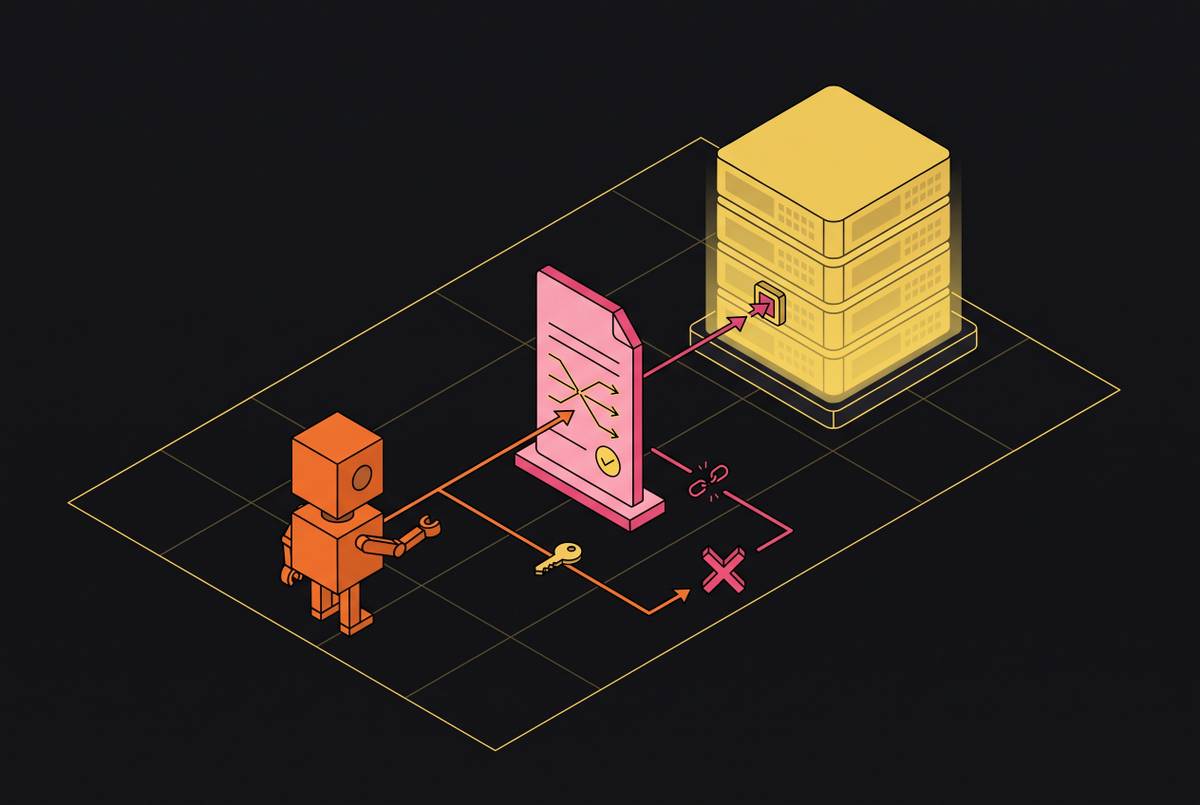
Grounding AI agents in customer-owned warehouse data through embedded integration requires a governed access layer. Data contract testing makes that layer dependable by combining schema-constrained generation, protocol validation, application checks, warehouse gates, and governance. These controls catch malformed or misinterpreted data at each handoff, before a model can turn a boundary violation into a confidently wrong answer.
Implementing data contract testing for agent-consumed export pipelines requires five complementary enforcement layers: schema-constrained generation, protocol validation via MCP inputSchema and outputSchema declarations, application-level checks with Pydantic or Pandera, warehouse gates through dbt model contracts, and governance through ODCS 3.1 with Data Contract CLI. The workflow starts contract-first: declare the shared output schema in JSON Schema, Pydantic, or Zod before writing the prompt or the consumer, version that schema independently of the model, and reference it from a shared registry on both sides. Failure behavior belongs in the design as well, with generation refusals returning to the caller, tool errors returning to the model, validation failures following a dead-letter path, and schema drift failing the build. In CI, Data Contract CLI lints ODCS YAML, tests quality expectations against live sources, and fails the pull request on mismatch, while dbt adds a preflight gate before an incompatible model reaches downstream consumers.
Why agent pipelines fail at schema boundaries in ways traditional pipelines do not
A model that gets a malformed tool result can keep going by improvising around data that is missing or differs from what it expects. Downstream steps then consume that improvisation as input. That improvisation may produce a confidently wrong answer several hops later, without a causal trace to the original boundary. By contrast, a traditional pipeline receiving a malformed row can crash loudly, with a stack trace pointing back to the handoff that broke. The distinctive danger is not simply failure, but failure that remains plausible.
Parsing success does not establish that a payload is usable. A result may contain a None where a string was expected, or a list where a scalar was expected, yet still parse without error. The bug travels before anything visibly breaks. Every agent turn also crosses several producer and consumer boundaries, including model-to-tool, tool-to-model, agent-to-agent, and agent-to-warehouse. In a naive implementation, those boundaries depend on whatever JSON the model happens to emit rather than an explicit agreement about what the next stage can accept.
Why traditional contract testing assumptions break down when the producer is a language model
When output is probabilistic, two assumptions behind traditional consumer-driven contract testing break down: exact equality assertions and provider replay testing. An assertion that a provider returns exactly one response is unsuitable when a model can legitimately vary its output within a valid schema. There is no single canonical model response to record. Replaying a recorded response can test how the consumer behaves, but it cannot show that future model outputs will have the same required structure. A model upgrade, prompt adjustment, or temperature change can alter the shape without triggering a traditional breaking-change alert.
A contract can require that sentiment belongs to a known set, confidence is a float within a declared range, and entities is an array of objects with specified fields. It need not prescribe which permitted values appear. The consumer-driven pattern therefore survives, with the downstream stage declaring its requirements and the upstream stage testing that it meets them. A change from user_id to userId, for example, breaks the contract even if the rest of the response reads well and looks like something the consumer can use.
How the enforcement stack maps onto agent pipeline boundaries, layer by layer
Reliable enforcement requires five layers, which are generation, protocol, application, warehouse, and governance. They are complementary controls. At generation, schema-constrained sampling prevents malformed model output that prompting alone can only discourage. Naive JSON prompting fails a meaningful fraction of the time under production load, while constrained decoding pushes structural failures toward near-zero. However, generation constraints cannot repair a malformed warehouse export or validate a tool result that the model did not generate.
The protocol layer extends enforcement to tool exchanges through MCP inputSchema and outputSchema declarations. The MCP tools specification requires servers to provide conforming structured results when an output schema is declared and says clients should validate those results. Declarations alone are therefore not the whole control. Enforced violations return a result with isError set to true, rather than silently passing malformed data downstream. This protects the exchange, but it does not by itself resolve mismatches in the warehouse data that the tool reads.
Pydantic validates JSON or dictionary records, but its default mode coerces types, while strict mode rejects coercions and requires matching types. A single ValidationError includes all field failures, and @field_validator adds business rules within the schema definition. Pandera covers table-level validation for Pandas or Spark batches, with @pa.check_types checking function arguments at call time. Its strict = "filter" option drops extra columns rather than raising an error, so an unexpected field does not become a visible violation under this configuration. Malformed records can then follow a dead-letter path without blocking the pipeline or disappearing silently.
With warehouse enforcement, dbt model contracts run a preflight schema check before each build and fail the build on a mismatch, so structural rejection happens before the export. Dead letter tables keep records that fail validation so they can be reprocessed later, while keeping them away from consumers. Even when a field has the right structure, these controls and application shape checks cannot show that it still has the meaning, owner, or service commitment the consumer expects.
Governance supplies those missing dimensions through ODCS 3.1 and executable contract checks. Data Contract CLI natively supports ODCS, validates contracts against its JSON Schema, and tests actual data against schema and quality expectations. It connects to sources including Snowflake, BigQuery, Databricks, Postgres, Kafka, and S3, and exports to 25+ formats including SQL DDL, dbt, Avro, JSON Schema, and Protobuf. ODCS keeps logical types that work across platforms apart from physical types that depend on the warehouse. That distinction supports portable definitions, while ownership, SLA tracking, versioning, and semantic meaning make the contract more than a schema.
Contract-first design means defining the schema before writing the prompt or the consumer
To put the stack into practice, teams should define the shared output schema before writing either the prompt or the consumer. The fragile alternative starts with a prompt, observes its responses, and builds a parser around them. That leaves the agreement implicit in consumer code. A contract-first workflow instead declares the schema in JSON Schema, Pydantic, or Zod, then uses it to configure structured output on the producer and ingestion validation on the consumer.
The schema should have its own version, independent of the model version. Producer and consumer should reference that version from a shared registry. When the producer’s schema changes, the workflow is to increment the version, update the consumer, and run the full contract test suite before deploying either side. Failure behavior also belongs in the contract design. Generation refusals should go back to the caller, tool errors should go back to the model so it can correct itself, validation failures should take a dead-letter path, and schema drift should fail the build.
Atlan’s MCP server lets agents retrieve certified definitions and access policies before constructing a query, so they can validate their understanding before applying it. Atlan’s AI Labs found that AI text-to-SQL accuracy rose by 38% when this context was added. Meaning becomes an input rather than an afterthought. The same principle applies to agents modifying code, because executable contracts and commands in the repository let them test their changes, whereas rules confined to a wiki or comment can be missed.
CI/CD gates and runtime enforcement turn contracts from documents into controls
A contract becomes a control when an incompatible change cannot pass the delivery gate. In CI, Data Contract CLI can lint ODCS YAML against its JSON Schema, test quality expectations against the actual source, and fail the pull request when a test fails. dbt adds a preflight gate before an incompatible model reaches downstream consumers. No manual review is required for that rejection. The shared schema registry also supports a separate release rule, under which a schema change without a version increment fails CI.
Consumer-driven tests add to those checks by testing whether the model producer returns the shape the consumer has declared. The upstream stage runs the assertions against a sample of its output, while both sides test independently against the shared contract in a broker. Pydantic and Pandera checks at each ingestion boundary provide structured failures when an output escapes earlier controls, provided their configuration rejects the relevant mismatch.
Tredence implemented data contracts in Databricks pipelines for industrial AI, with sensor producers guaranteeing that particle counts met consumer ML model expectations and significantly reducing inference errors. The operational principle is a producer guarantee that can be tested automatically. For agent pipelines, that guarantee must survive changes to prompts, models, and configuration as well as changes to source data. Runtime ingestion checks are still needed even when teams trust upstream structured output, because those changes can get past generation-layer enforcement.
How can AI agents access customer-owned warehouse data without direct pipeline access?
An embedded connectivity layer provides the handoff between customer-owned data and agent-facing tools and must enforce the contract as it transports records. For SaaS teams, syncing data to a customer’s warehouse, database, or object storage creates a platform-level producer and consumer boundary. That boundary needs its own enforcement. When comparing embedded integration with bespoke integration, teams should check how each makes schema changes known before they reach the agent. Schema changes should be explicit, versioned events.
A single ODCS contract can describe data landing in BigQuery, Snowflake, or Redshift with appropriate warehouse-specific type mappings. The agreement travels with the export destination. By contrast, a schema definition confined to one system does not express the full handoff across platforms. The export layer therefore needs to preserve both the consumer’s logical expectations and the destination’s physical representation.
Security and residency are also contract constraints. Each sync destination gives enterprise compliance teams another place to audit, so connectivity requirements need to account for SOC 2 Type II certification and optional private-cloud deployment. Private-cloud deployment can keep data within the customer’s VPC. Governance must also account for agents that query systems, invoke tools, and make decisions autonomously, rather than assuming that human-oriented RBAC/ABAC rules and lineage practices transfer unchanged. Secure embedded access depends on these controls as well as schema validity.
Embedded React SDKs and clean APIs let teams offer export as a first-class product feature without a bespoke integration project. Support for high row volumes per destination without data-transfer fees that scale against volume removes a pricing incentive to route around validation gates. The connectivity layer belongs in the same reliability review as the application and warehouse, because its behavior under change determines what reaches the agent.
How do you implement data contract testing for AI agent pipelines that consume warehouse export data?
For an end-to-end implementation, teams should begin with the registered schema and connect each enforcement point to it. OpenAI strict mode or Anthropic strict tool use constrains generation, while MCP declarations and validation govern tool inputs and outputs. Pydantic or Pandera then validates ingestion at every downstream stage. dbt contracts reject shape mismatches before warehouse models ship, and an ODCS-compliant document supplies the owner, schema, quality rules, SLA, and terms for governance checks. Data Contract CLI tests against live sources in CI connect those declared expectations to actual data.
These controls can map naturally onto medallion architecture. Schema enforcement belongs at silver, where data is cleaned and standardized, while quality gates belong at gold, where it becomes business-ready. Agent-facing validation belongs at the platinum or serving layer. The semantic catalog then lets the agent retrieve certified definitions and access policies before constructing a query, connecting governance to runtime behavior.
The organizational requirement is to treat every export handoff as a shared contract surface. Producer teams, consumer teams, and connectivity owners need explicit responsibility for the guarantees enforced there and the response when those guarantees fail. No single tool supplies that agreement for them. Teams that establish it can catch violations where they occur, instead of diagnosing them three hops later from an agent’s confidently wrong output.