Vendor Capability Checklist for Embedded Integration That Keeps Agent Queries Inside Customer-Owned Data Boundaries
Evaluate embedded integrations by their data isolation controls, not just connector breadth.
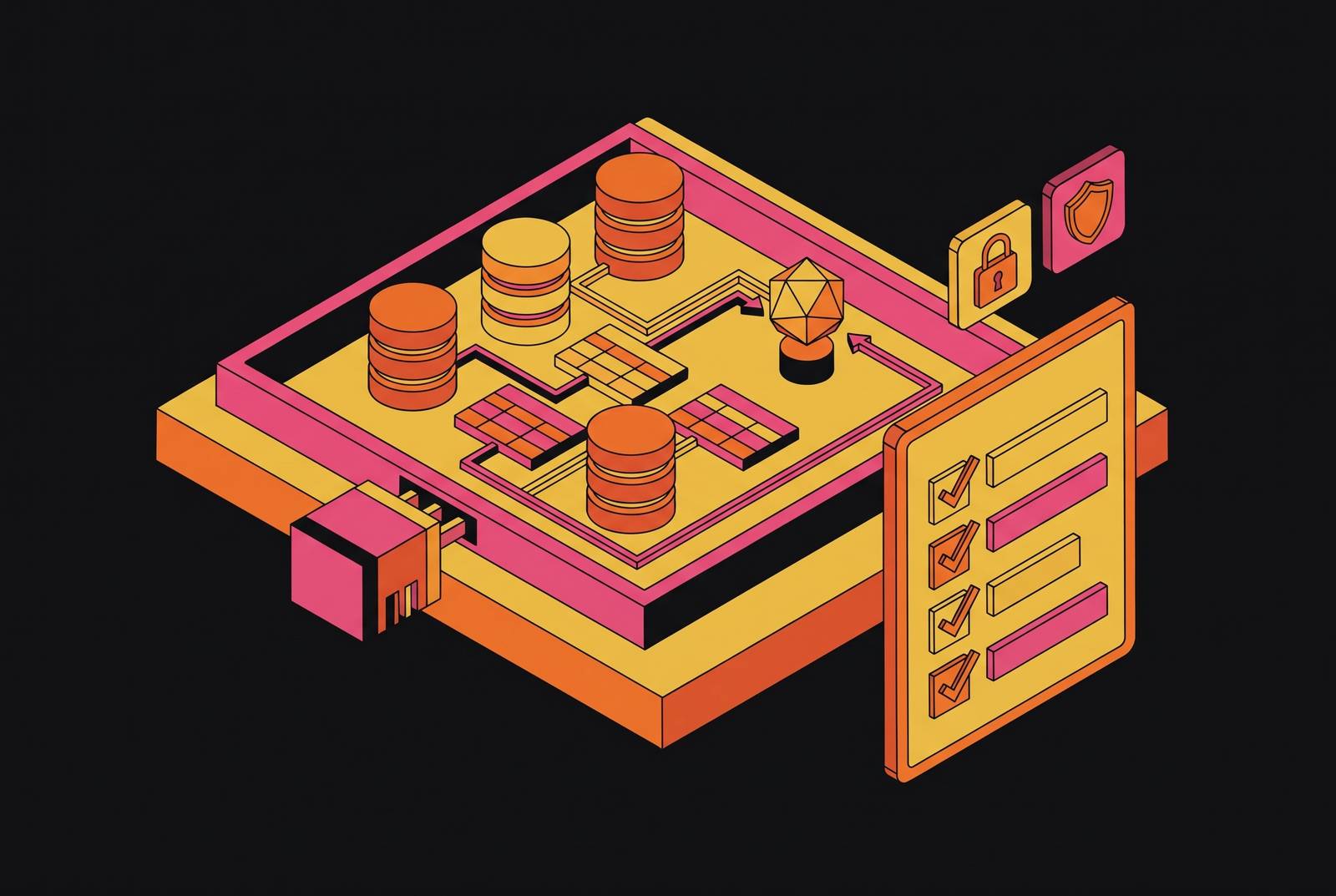
AI agents can answer questions grounded in customer-owned warehouse data without direct pipeline access when an embedded integration layer enforces tenant identity, query permissions, and customer-controlled storage. Selecting that layer requires evidence across seven capabilities, from payload handling to isolation under load. Connector breadth, MCP support, and compliance credentials cannot substitute for architectural controls over where queries execute and what they return.
Why generic integration checklists fail when AI agents enter the picture
Generic integration checklists evaluate throughput, connector breadth, and uptime. Those criteria establish whether an integration can move data reliably, but not whether an autonomous agent is authorized to retrieve it. Agents call integrations directly and can build requests without the judgment a human user would use. The platform must therefore enforce the boundary before execution.
This changes the platform selection decision itself. Managed multi-tenant authentication and agent-level controls belong in the initial evaluation. Application-level restrictions are not enough when the agent can query beneath them. The product team is still responsible for the data this exposes, so teams must assess the vendor by following the data path from infrastructure and credentials through query enforcement, storage, and how the system runs in production.
What “customer-owned data boundary” means when connecting agents to warehouse data
A customer-owned data boundary ties data to a specific tenant, places it in or directs it toward infrastructure that tenant controls, and prevents another tenant’s session or agent invocation from accessing it. Ownership alone is not enough to establish isolation. In an embedded multi-tenant product, the boundary has both a storage surface and a query surface, and each needs its own controls.
The storage surface determines where data lands, such as the customer’s warehouse, database, or object storage, separate from shared vendor infrastructure. The query surface determines what an agent may retrieve under the authenticated tenant’s identity. The platform injects tenant scope before the query executes, rather than relying on a UI filter that a modified request can bypass. Broad agent read access defeats that separation immediately. Granting it temporarily, with restrictions planned for later, leaves the boundary unenforced during the period when the agent can already return another tenant’s data.
Checklist category one: white-label architecture and whether vendor infrastructure touches customer data
A vendor that receives, buffers, or persists customer payloads becomes a data-handling intermediary inside the customer’s compliance perimeter. Its role does not change with its branding. The white-label test therefore examines OAuth screens, vendor-controlled domains in authentication, and vendor-side storage of API response payloads. Third-party branding is a visible signal that vendor infrastructure participates in the flow, but the assessment must extend beyond what the customer sees.
Persistence depends on whether API response payloads reach vendor disk or database storage at any point during sync. That storage expands audit scope and creates data outside the customer’s independent inventory, encryption-key control, and deletion control. Zero-payload-storage or pure pass-through architecture removes that persistence exposure. Teams should require the data processing addendum, or DPA, to support the claim.
Deployment options provide a separate architectural test. Private-cloud or on-premises deployment can remove shared vendor infrastructure from the data path for strict residency requirements. The conversation should establish availability and tier, whether the DPA identifies the vendor as a sub-processor, and whether its coverage includes AI agent invocations.
Checklist category two: per-tenant credential isolation and scoped agent identity
A misconfigured credential scope can let an agent retrieve one customer’s data while acting for another. Application-layer segmentation does not repair a shared credential pool. Each tenant’s credentials must be stored, scoped, and refreshed independently by the platform so that an application scoping error does not expose access across tenants. When User A requests CRM records, the agent’s credential scope must bind to User A’s integrated account.
Agent identity needs its own boundary as well. An agent should have a distinct non-human identity with the minimum permissions required for its task. Its access must be revocable per agent, tenant, and session without disrupting other tenants.
The vendor conversation should establish whether credential pools are shared, whether agent permissions can be audited, and whether agent identities can be issued and revoked independently of human credentials. It should also address active work explicitly. When a customer revokes access, the vendor needs to explain whether in-flight queries terminate.
Checklist category three: row-level and column-level enforcement at the sync layer
Permission to access a destination does not determine which records and fields an agent may retrieve from it. Row-level enforcement supplies the missing record boundary. The platform or analytics layer reads the tenant identifier from the authenticated session and injects a filter before execution, including when the destination contains commingled tenant data. A filter confined to the presentation layer cannot provide that protection against modified requests.
Column-level masking restricts fields within otherwise permitted records. A fraud detection agent can get transaction amounts and timestamps while card numbers and customer names stay masked. Access to the surrounding transaction is legitimate, but access to every field is not. The governance layer must enforce that distinction when returning data.
For agents that construct their own queries, this is a central architectural requirement. Application filtering applied to a prebuilt response does not govern a query that bypasses that response path. Teams should ask whether the enforcement layer intercepts autonomous queries before execution, whether masking can vary by tenant or data classification, and whether row-level and column-level rules can be audited independently of the queries that trigger them.
Checklist category four: destination-side data residency and storage architecture
A promise to use a regional datacenter does not give the customer control over destination data. The destination itself must be customer-owned and controlled. Data should land in the customer’s Snowflake, BigQuery, Databricks, database, or object storage instance, rather than a vendor-managed store available only through a vendor interface. The customer must retain the ability to query, restrict, encrypt, and delete it independently. Vendor unavailability should not remove access to the synced data.
Object storage requires the same ownership test. S3 API compatibility allows a sync mechanism to work across compatible providers, but says nothing about who owns the bucket. Teams should establish that writes reach the customer’s bucket and that granular IAM policies, immutability controls such as WORM / Object Lock, and lifecycle management can apply there.
Customer-managed encryption keys, including CMEK/BYOK, place control of the protecting key with the customer. If the vendor holds that key, where the data is stored is not enough to back the residency claim. The assessment should therefore cover both destination ownership and continued access if the vendor platform is suspended or terminated.
Checklist category five: MCP support and what the protocol does not provide
MCP is an important development because it standardizes how AI agents discover and invoke exposed tools. That standard interface makes support a relevant selection requirement. It does not, however, define role-based access control, enforce tenancy, or decide which data an agent may retrieve.
The platform must add identity, tenant scoping, policy enforcement, and audit controls on top of that protocol. These controls need to apply at session initiation and to every tool invocation. An MCP server that shares context across tenants can cross the same boundary as a mis-scoped database query.
Teams should require documentation showing how the server binds each invocation to the authenticated tenant’s credentials. The vendor should name the policy engine or other mechanism that intercepts calls and applies restrictions before they run, and show whether invocation logs are scoped per tenant. Revocation also needs a tool-level answer. The assessment should establish what happens to active calls when credentials are revoked mid-session, rather than treating initial authentication as sufficient evidence of continuing authorization.
Checklist category six: compliance posture and what SOC 2 Type II does and does not cover for agent use cases
SOC 2 Type II is the minimum credible compliance baseline for this evaluation. Type I attests to control design at a point in time, while Type II attests to operating effectiveness over a period. An unspecified claim of “SOC 2 compliant” may refer only to Type I.
The report’s scope then determines its relevance. The five Trust Services Criteria are Security, Availability, Processing Integrity, Confidentiality, and Privacy, but most vendors scope only Security. Teams should inspect the actual report for included criteria and infrastructure. A sync pipeline or MCP server introduced after the audit period may fall outside its coverage.
Agent-specific engineering evidence is needed alongside attestation to establish that queries use the correct tenant scope and that MCP calls remain isolated. Security documentation should also specify AES-256 at rest and TLS 1.2 or higher in transit, with end-to-end protection from source to destination.
HIPAA requires a signed BAA, and its coverage should include both human interactions and agent data flows. Residency assessment likewise needs infrastructure diagrams showing where data transits and rests. Private-cloud or on-premises options still matter when those requirements rule out shared vendor infrastructure.
Checklist category seven: throughput architecture and whether scale breaks the boundary
Concurrent multi-tenant agent load is the production test of every preceding control. Agents can issue bursts without human pacing. Teams therefore need proof that isolation works when tenants are active at the same time, even if it holds for a single tenant at low throughput. A shared execution pool without per-tenant resource limits allows one tenant’s agent to exhaust resources that another tenant depends on for data access.
High-volume syncs place related pressure on tenant tagging and scoping. Teams should establish that tenant tags are applied at ingestion, rather than assigned retroactively during queries in a way that could be bypassed under load. Query-time authorization remains necessary, but it should not compensate for missing tenant attribution in the synced data. The vendor should document isolation testing under concurrent multi-tenant agent activity.
Capacity limits make that evidence operationally useful. The conversation should establish the documented throughput limit per destination per sync cycle and whether burst conditions preserve tenant-specific resource controls. Pricing deserves a brief check as well. Destination-based pricing aligns with data-volume growth, while per-row or per-transfer pricing can create incentives to constrain throughput in ways that affect sync completeness.
How to use the checklist to score a vendor conversation
The seven categories depend on one another, so teams cannot score each one on its own. Strong compliance cannot make up for a payload-handling architecture that fails the team’s requirements. Teams should begin with vendor infrastructure and credential isolation, because unsatisfactory answers there make later capabilities insufficient for strict boundary requirements. Row and column enforcement, destination ownership, and MCP scoping then test how far isolation reaches. Compliance and throughput provide the final production-readiness gate.
Vendors need to back what they say with evidence from the same architecture. The DPA should establish sub-processor status, payload persistence policy, and coverage of agent invocations. The actual Type II report should show what the audit covered, which criteria it included, and whether the relevant infrastructure was in place during the audit period. An architecture diagram should locate transit, storage, and vendor participation, while tenant-isolation documentation should explain credential separation, tool-call scoping, and row-level controls. None of these documents substitutes for the others.
A vendor positioned for agent use cases should be able to explain architecture and isolation as core product properties. A vendor that clears all seven categories has demonstrated architectural, rather than cosmetic, boundary enforcement. That is the bar agent-safe embedded integration requires.