Backfill Strategies for Adding New Columns to Live Export Pipelines
Three strategies let you safely backfill new columns without duplicating customer data.
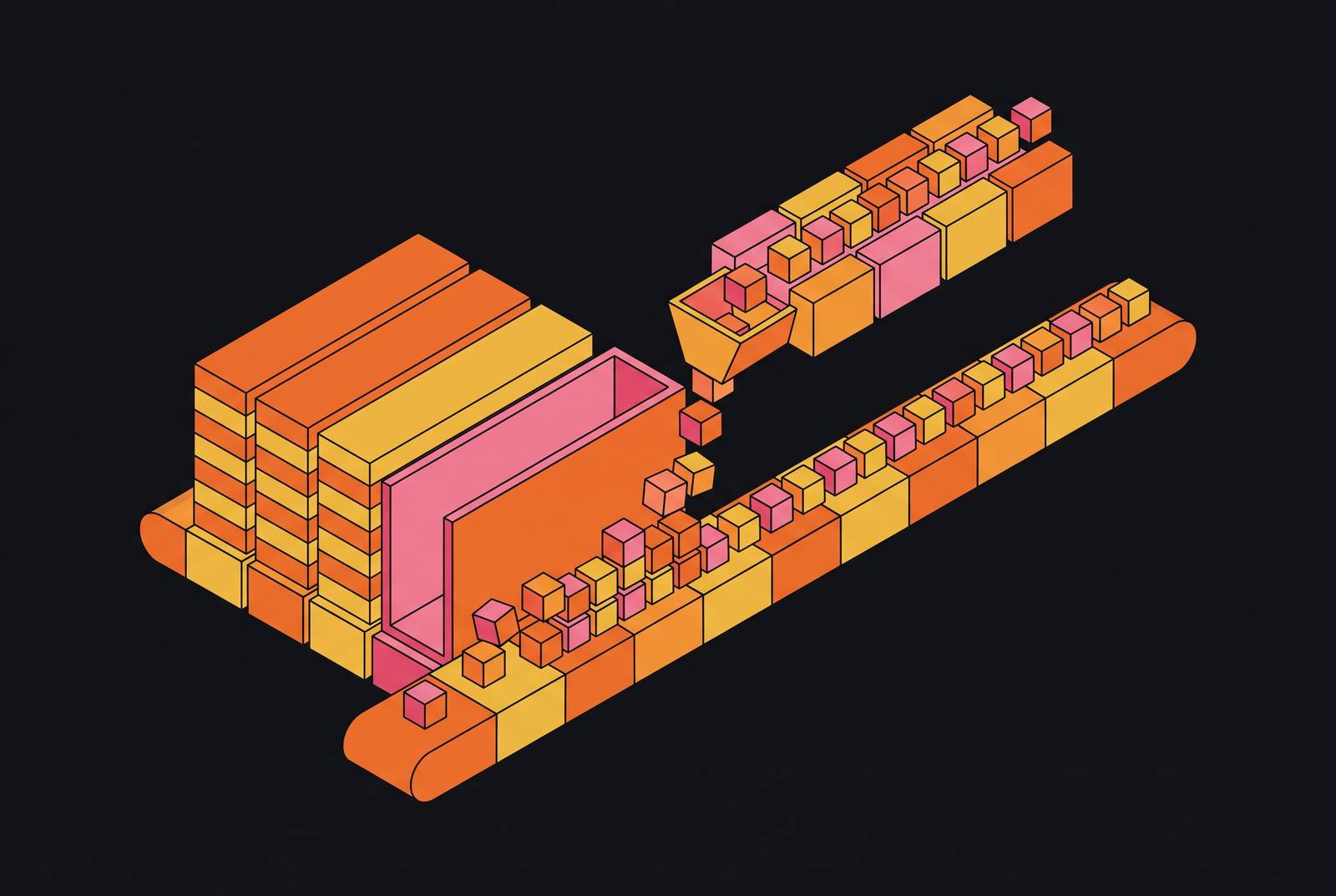
Adding a new column to a live export pipeline involves both a schema change and a write-path problem. The safe approach is to choose recompute, replay, or dual-write to fit the architecture, then control how historical and live writes meet. Idempotent writes, partition isolation, and throttled execution can keep customer data consistent and prevent a production incident.
Why adding a new column to a live export pipeline is not a simple schema change
A Monday dashboard showing 4× real revenue is the classic consequence of a naïve backfill that appends rows already present. The schema change may have succeeded, but the historical rewrite has duplicated the facts behind the dashboard. Another collision can produce the opposite problem when a late live task overwrites a partition the backfill just corrected. Both failures happen when historical and live processing write to the same target without enough isolation.
The need for that historical processing starts when the new column is populated from today while historical rows remain NULL. To make the column consistent across the full history, the pipeline must reprocess the past without disrupting current writes. In an export pipeline, a mistake lands directly in customer warehouses, databases, or object storage, where customers may see it before the team does. An ad-hoc rerun therefore cannot substitute for a deliberate strategy and a controlled write boundary.
The three canonical backfill strategies and when each one fits
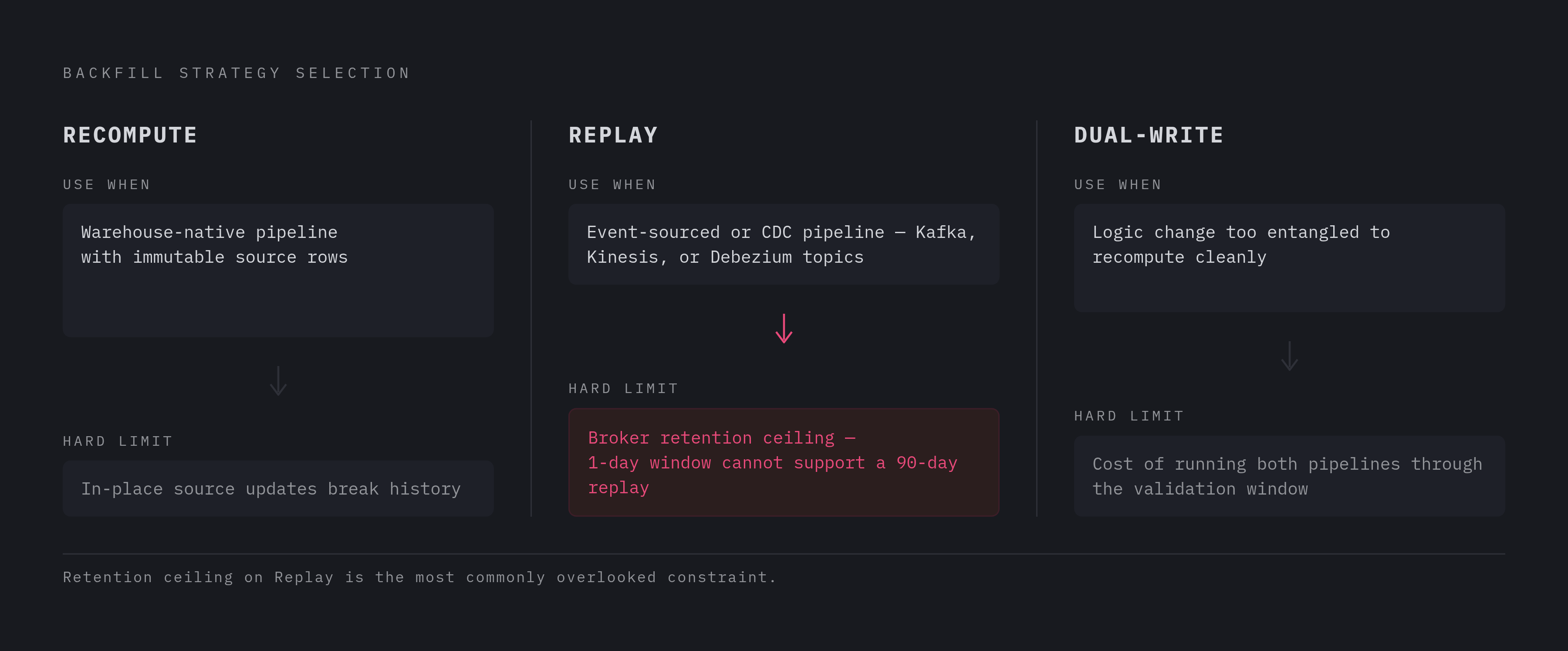
Recompute fits warehouse-native pipelines whose immutable source rows remain in raw storage. It runs the current transform over historical partitions and overwrites each partition. This makes it cheap and repeatable without coordination with the source system. But if source rows have been updated in place since the original run, recompute cannot count on them to show the history as it was.
Replay fits event-sourced and CDC pipelines when immutable events remain available for the entire backfill window. Historical events are consumed again from Kafka, Kinesis, or a Kafka topic fed by Debezium. A new consumer group keeps that work separate from the live consumer. Retention is the hard limit, since broker retention of one day cannot support a 90-day replay.
Dual-write fits large logic changes when the old path is too entangled to recompute safely and equivalence cannot be proved offline. The new pipeline runs beside the old one, writes to a separate target table, and catches up before readers switch after a validation window. Its limitation is the cost of running both paths simultaneously. None of these strategies is universally best, but recompute is the first choice for batch warehouse work, replay for event-sourced systems, and dual-write for migrations.
Why idempotent partition writes are the non-negotiable prerequisite for any of these strategies
Strategy selection does not make retries safe by itself. An idempotent pipeline produces the same result every time it processes the same input. For partition-based processing, the workhorse pattern is deterministic partition overwrite, with each run atomically replacing one partition. If the pipeline lacks that property, fixing it comes before starting the backfill.
In Spark, the pattern means filtering to a single event_date and using partition overwrite mode so only that date is replaced. In BigQuery, a partitioned table lets the backfill target specific partitions without rewriting the whole table. Databricks pipeline documentation also requires backfill flows to handle duplicates gracefully when the same data is appended more than once. The shared requirement is that reprocessing must not multiply the result. A production track record does not establish that safety, because append-only writes can serve incremental loads successfully and still break when a historical partition is processed again.
Schema evolution must be handled before the backfill starts, not during it
Idempotent writes protect the destination, but the ingestion layer must first accept the schema change correctly. Tools may evolve by adding compatible columns on their own, freeze by failing when the source breaks the declared contract, or discard data that does not fit. The team must know which mode is active before it can safely process historical data. Otherwise, a backfill can fail or silently drop data before its write safeguards matter.
Schema interpretation also has to span the historical and current formats. Avro object container files embed a schema, while Protobuf and JSON Schema require an external schema or registry to interpret records. Backward compatibility lets newer schema versions read older data, forward compatibility lets older versions read newer data, and full compatibility supports both directions. Full compatibility is therefore the most conservative choice for these backfill scenarios.
Databricks backfill documentation explicitly calls for compatibility between historical and current schemas before a backfill flow runs. That requirement matters when current code encounters old partitions with different column names or types. Test the backfill logic on a sample of old partitions before running it on all of them. Schema readiness is a gate before execution.
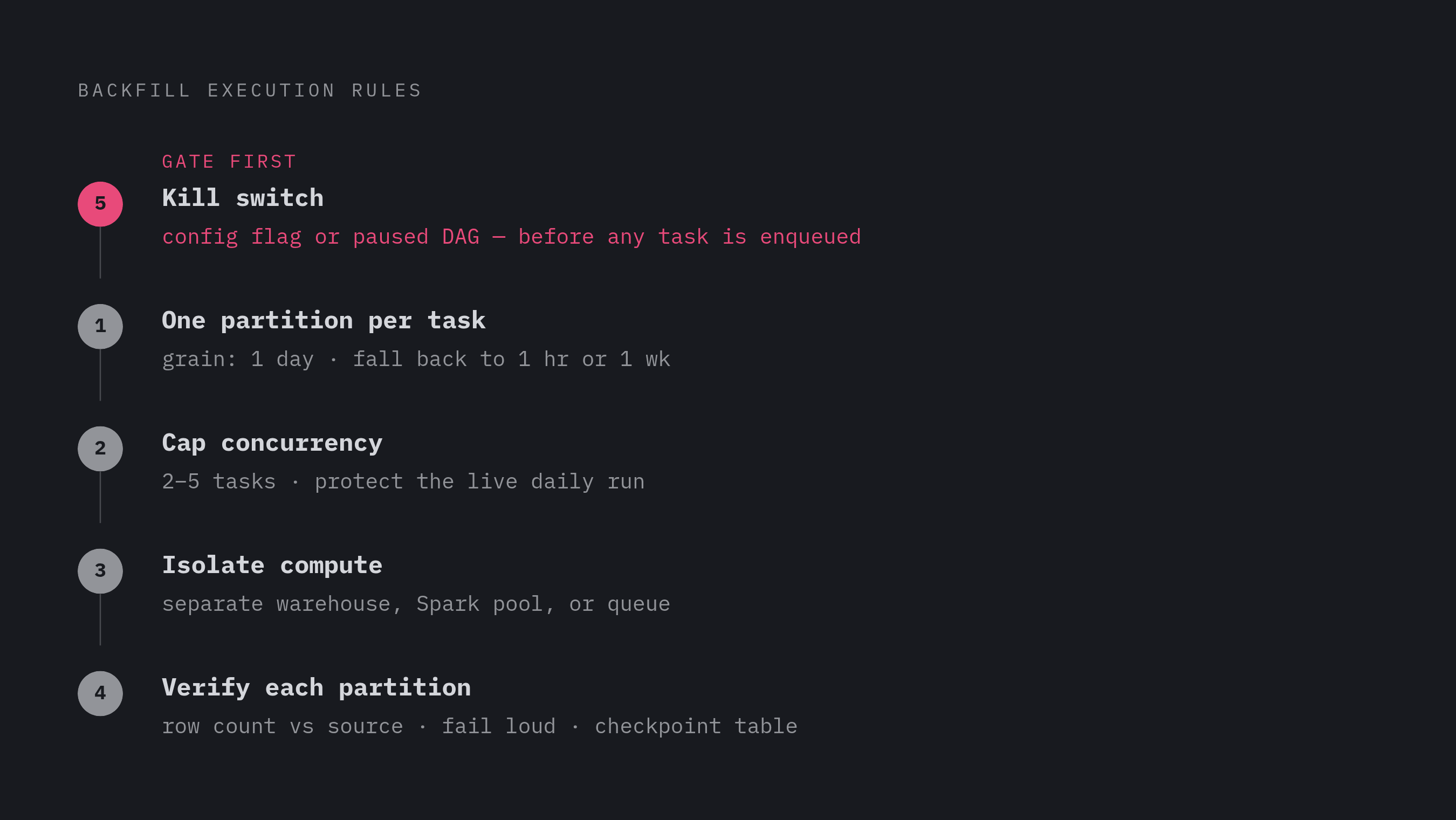
The partition-at-a-time execution playbook: five rules that keep a backfill from becoming an incident
The first rule is one partition per task, with a day as the default grain. Use an hour if a day is too large to finish reliably, or a week if a day is too small. The boundary should match what one task can complete in a reasonable window. Without it, an oversized task risks timeout or resource exhaustion.
The second rule is to cap concurrency, with two to five concurrent tasks as the practical range. Too many tasks can starve the live daily run, while too few can make the work last longer than the team can watch it. In Kafka replay, a new consumer group ID also leaves the live pipeline’s offsets undisturbed.
The third rule is to isolate compute through a separate warehouse, Spark pool, or Airflow queue. Without that separation, historical processing competes with live dashboards and customer-facing pipelines. Databricks backfill documentation recommends increasing max workers when not using serverless compute so historical processing does not crowd out current streaming data within the expected SLA. Serverless with enhanced autoscaling handles that capacity adjustment automatically.
The fourth rule is to verify each partition before moving on. Compare its row count with the source count, the last good run, or a sibling pipeline, and fail loudly when the gap exceeds a tight threshold. Record successful partitions in a state table or file so a failure can resume from the last checkpoint. Without these controls, errors can accumulate unnoticed and restarts repeat completed work. A watermark table that tracks the last-processed time for each partition also helps handle late events that arrive after a partition was backfilled.
The fifth rule is to have a kill switch before execution starts. A configuration flag or paused orchestration DAG must stop new tasks from being enqueued. Airflow supports historical DAG backfills and, separately, clearing task instances so the scheduler re-queues them, which provide controlled rerun paths.
Multi-tenant blast radius: why a backfill in a SaaS export pipeline is not a single-customer problem
Each customer’s warehouse, database, or object storage destination is a separate write path, so historical records must be scoped by tenant as well as partition. Otherwise, one tenant’s recomputation can corrupt another’s data or cross a residency boundary. The blast radius can extend across the customer base.
That isolation must keep credentials, access controls, and data residency constraints in place for the whole run. Backfilled data should land in a staging area for each tenant and pass validation before it moves to the live destination. For embedded connectivity products built on white-label platforms, the end customer does not start the platform-level backfill. The SaaS vendor must execute it safely on behalf of all tenants without making customers manage the underlying complexity.
SOC II and audit requirements that a large backfill must satisfy
A large historical rewrite is a change-management event as well as an engineering operation. SOC 2 (CC8.1) Change Management criteria cover whether changes have been authorized, tested, approved, and implemented through formal review. A backfill can lead to a compliance finding if it has no formal change record and audit trail. The approval gate and audit log belong in the runbook as engineering controls established before execution.
For large date ranges, approval must precede task enqueueing. Audit logs must record who requested the backfill, the date range, and before-and-after row counts. The metrics and alerts for each partition belong in the same observability stack used for normal pipeline runs. Automatic resume from the last successful checkpoint also prevents a restart from rewriting already-audited partitions.
When residency requirements call for it, backfill compute must stay within the same boundary as the live pipeline. A private-cloud or isolated-network deployment must keep the work from going through a vendor-managed environment outside that boundary. End-to-end encryption must also hold, because historical data in transit has the same sensitivity as live data.
Where the standard playbook breaks down: three real tensions practitioners disagree on
The first tension is between finishing promptly and containing compute cost. A multi-month backfill can compress a large amount of processing into hours, exhausting warehouse credits or Spark quotas before completion. Query timeouts or credit limits for each warehouse should be set before the run starts, so costs have a kill switch too. Dual-write makes this tradeoff easy to see because both pipelines run through a validation window that can last weeks.
The second tension concerns the meaning of missing values: when historical data has no value for the new column, the team must decide whether a missing value means unknown, unavailable, or a valid default. Filling unknown quantities with zero can produce tidy aggregates that misrepresent history. A downstream analyst or AI agent cannot distinguish a true zero from an imputed one merely by reading the value. The decision depends on business meaning and must be documented in the column’s metadata before the backfill runs.
The third tension concerns how much authority to give AI agents that detect schema drift and generate or modify pipeline code. An agent that triggers a large backfill without human review bypasses the required approval step. For large date ranges or customer-facing export targets, the rule should be agent-proposes, human-approves. Yet delaying the backfill also leaves any agent reasoning over the new column with structurally incomplete context. The backfill is therefore a prerequisite for AI feature correctness, while its execution still requires controlled approval.
Building backfill-readiness into the pipeline from the start
Depending largely on how the pipeline is built, a backfill can take an afternoon or require two weeks of manual intervention. Partition-aware reads and writes, durable checkpoints, explicit schema evolution, and partition-level audit logs make historical processing a supported capability. Databricks backfill documentation illustrates that approach with the append-once flow pattern, which keeps backfill code in the pipeline definition so a full refresh runs it again automatically. The important design choice is to give historical processing a permanent, controlled place in the system.
For SaaS export products, the platform itself must also have destination isolation, per-tenant partition scoping, and end-to-end encryption built into that design. Those properties cannot depend on each runbook reconstructing the same protections. When they are built in, adding a column becomes routine schema evolution with a controlled historical update.